A Children's Book That Solves One of Divorce's Hidden Burdens
When seven-year-old Emma started counting her hugs—two for mom, two for dad, exactly even—her mother knew something was wrong. But she didn't know what to call it, or how to help.
This is the invisible weight countless children of divorce carry: the exhausting work of keeping their love perfectly balanced between two homes. They count kisses. They track time. They measure every cookie, every bedtime story, every moment of joy to ensure neither parent feels shortchanged. And in doing so, they transform love from something spontaneous and abundant into something that requires constant vigilance.
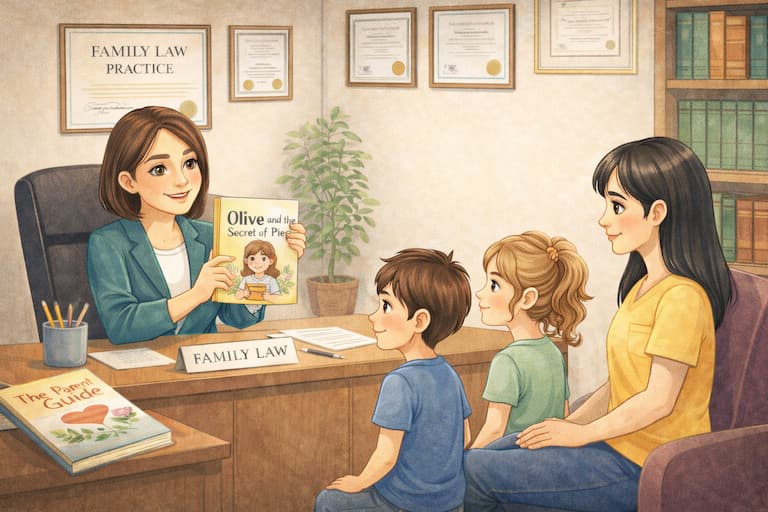
Olive and the Secret of the Pies, a soon-to-be released children's book, offers both a name for this phenomenon and a remarkably effective solution—one that family law professionals can put directly into the hands of their clients.
The Fairness Trap
As family law practitioners, we see the practical logistics of custody arrangements: the schedules, the transitions, the legal frameworks that divide a child's time between two households. But we rarely see what happens inside that child's mind as they try to navigate the emotional mathematics of split custody.
Olive and the Secret of the Pies identifies what many of us have witnessed but struggled to articulate: children often appoint themselves as the guardians of fairness between their parents. They become hypervigilant accountants of affection, convinced that showing more love to one parent somehow depletes what's available for the other.
The book's protagonist, Olive, meticulously counts everything—three bowls of cat food at Mom's house, three tomatoes picked in Dad's garden. Two hugs and five kisses for each parent, carefully tallied. It's heartbreaking because it's real. And it's exhausting work for a child who should simply be allowed to love freely.
The Pies Metaphor: Simple, Powerful, Memorable
What makes this book particularly valuable for family law professionals is its central metaphor: love as a pie.
Through a baking session with her grandmother, Olive learns that love isn't like one pie that must be split down the middle. Instead, it's like the special ingredient in Grandma's pies—you can pour all of it into every single pie you make, and it never runs out.
Olive bakes five pies in one afternoon—a lemon pie for Mom, a blueberry pie for Dad, a banana cream pie for her brother Joe, and pies for her aunt and uncle. Each pie receives her whole love. The one that takes longer to make doesn't contain more love. The one she makes quickly isn't less loved. Each receives everything she has to give.
The metaphor works because it's:
- Concrete: Children can visualize pies in a way they can't visualize abstract concepts like "emotional capacity"
- Empowering: It transforms love from a scarce resource into an abundant one
- Age-appropriate: The 6-8 year old target audience can grasp it immediately
- Transferable: Parents and professionals can reference "whole pies" in ongoing conversations
After learning the secret, Olive stops counting. She gives both parents "loads of big hugs and kisses, without counting." She whispers to her dad, "I love you with a whole pie."

Professional Resources That Extend the Impact
What elevates this book beyond typical children's literature is the inclusion of comprehensive professional guides. These aren't afterthoughts—they're carefully crafted resources that help you protect your client's most precious assets.
The Counselor Guide
The professional guide includes critical context such as a prominent warning: the book presumes both parents are safe and loving, and offers no framework for processing situations involving unkind, neglectful, or frightening parents.
For therapists and counselors, the guide offers targeted questions:
- "Do you sometimes feel like someone only deserves a small slice of your love?"
- "How comfortable do you feel talking to your parent(s) about this?"
- "What would time with [Mom/Dad] look like to make you feel the most full?"
These questions create openings for children to express complex feelings they may not have words for.
The Parent Guide
The parent guide takes a direct approach, asking caregivers to:
- Acknowledge that children attempt fairness as emotional regulation
- Take Action to relieve children of the burden of moderating fairness
- Model neutral, respectful language about the other parent
It suggests concrete practices: creating predictable handoff rituals (a "love pie" doodle in the backpack), saying "Love your [other-parent] with a whole pie" at transitions, and critically, avoiding asking children to compare or report on the other home.
The guide even includes a self-check for parents: "Are you using 'parent brain' or 'ex-partner brain?'"—a remarkably astute distinction that gets to the heart of many co-parenting challenges.
Practical Applications for Family Law Professionals
This book can serve multiple functions in your practice:
For divorce mediators: Recommend it early in the process as part of preparing parents for co-parenting. The "pies" language can become shared vocabulary for the family system.
For family law attorneys: Include it in client resource packets. When parents understand the fairness burden their children may be carrying, they're often more motivated to create cooperative parenting plans.
For guardian ad litems: Use the book's framework to assess how children are coping with divided custody. Are they exhibiting "fairness behaviors" that suggest they're carrying this burden?
For parent coordinators: Reference the "whole pie" concept in co-parenting communications. When a parent complains that a child seemed happier at the other house, you can reframe it using this shared metaphor.
For collaborative law teams: Suggest both parents read the book to their children separately, then discuss their reactions together. The author's guide specifically recommends this approach.
The Author's Credibility
Rob Arnold's credibility isn't academic—it's lived. He experienced his own parents' divorce as an adult at 30 and was surprised by the child-like emotions that surfaced, including an irrational need to track time spent with each parent "not just the number of visits, but also the hours and days."
Years later, as a divorced father of two daughters, he developed the pies metaphor organically while trying to help his children navigate split custody. The metaphor spread to their friends, then to other divorcing parents.
Now remarried with two stepsons, Arnold writes: "That's a lot of pies to juggle, but I've always said children are sent to raise their parents, not the other way around."
This perspective—that children are actively working to raise their divorcing parents—is precisely why this book resonates. It acknowledges the emotional labor children perform and offers them permission to stop.
What Sets This Book Apart
The children's literature on divorce is crowded with well-intentioned but often generic offerings. Most focus on reassuring children that the divorce isn't their fault or that both parents still love them. While important, these messages don't address the specific cognitive and emotional trap that many children create for themselves.
This book:
- Names the specific problem: The fairness burden, the emotional accounting, the exhausting work of keeping love even
- Offers a memorable solution: The pies metaphor that children can carry with them
- Includes professional resources: Guides that extend the book's impact beyond the initial reading
- Accounts for safety concerns: Acknowledges when the message doesn't apply
- Provides practical language: Phrases like "love with a whole pie" that families can use long-term
Implementation Recommendations
For family law professionals looking to integrate this book into their practice:
Immediate: Get notified when the book is published, and leverage bulk buying discounts to make them available for clients with children ages 6-8 going through divorce or recently divorced.
Short-term: Reference the companion guide (available free at olive-pie.com/guide) when discussing co-parenting plans. Suggest parents access it together when appropriate.
Long-term: Consider whether the "pies" framework could become part of your standard vocabulary when working with families. Simple phrases like "remember, they can love you both with whole pies" can defuse parental anxiety about uneven custody schedules.
In mediation: When parents express concern about fairness in parenting time, introduce the concept that children's love isn't divided by time spent. Reference the book's central insight: the pie that takes longer to make doesn't contain more love.
With colleagues: Share this with the mental health professionals in your network. Child therapists, play therapists, and school counselors working with children of divorce need this resource.
A Final Note on Timing
The book is written for children ages 6-8, specifically targeting the "pre-reader: read-to-me / early-reader: read-along" stage. This is intentional—both because children this age are concrete thinkers who can grasp the pies metaphor, and because parents at this stage are still actively reading to their children.
But as Arnold notes in his professional guide, the parents may need the message as much as their children. When both parent and child hear the story together, it creates an opportunity for shared understanding and new vocabulary for discussing difficult feelings.
Conclusion
Every family law professional eventually encounters the child who is working too hard to be fair, the parent who worries their child loves the other parent more, or the co-parenting relationship strained by perceived inequities in a child's affection.
Olive and the Secret of the Pies doesn't solve divorce. It doesn't eliminate the legitimate challenges of co-parenting. But it offers something specific and valuable: a way to help children stop doing emotional mathematics and return to what love should be—abundant, freely given, and unlimited.
In a field where we spend so much time dividing assets, time, and responsibilities, this book offers a refreshing reminder: some things can't be divided. And some things shouldn't be.